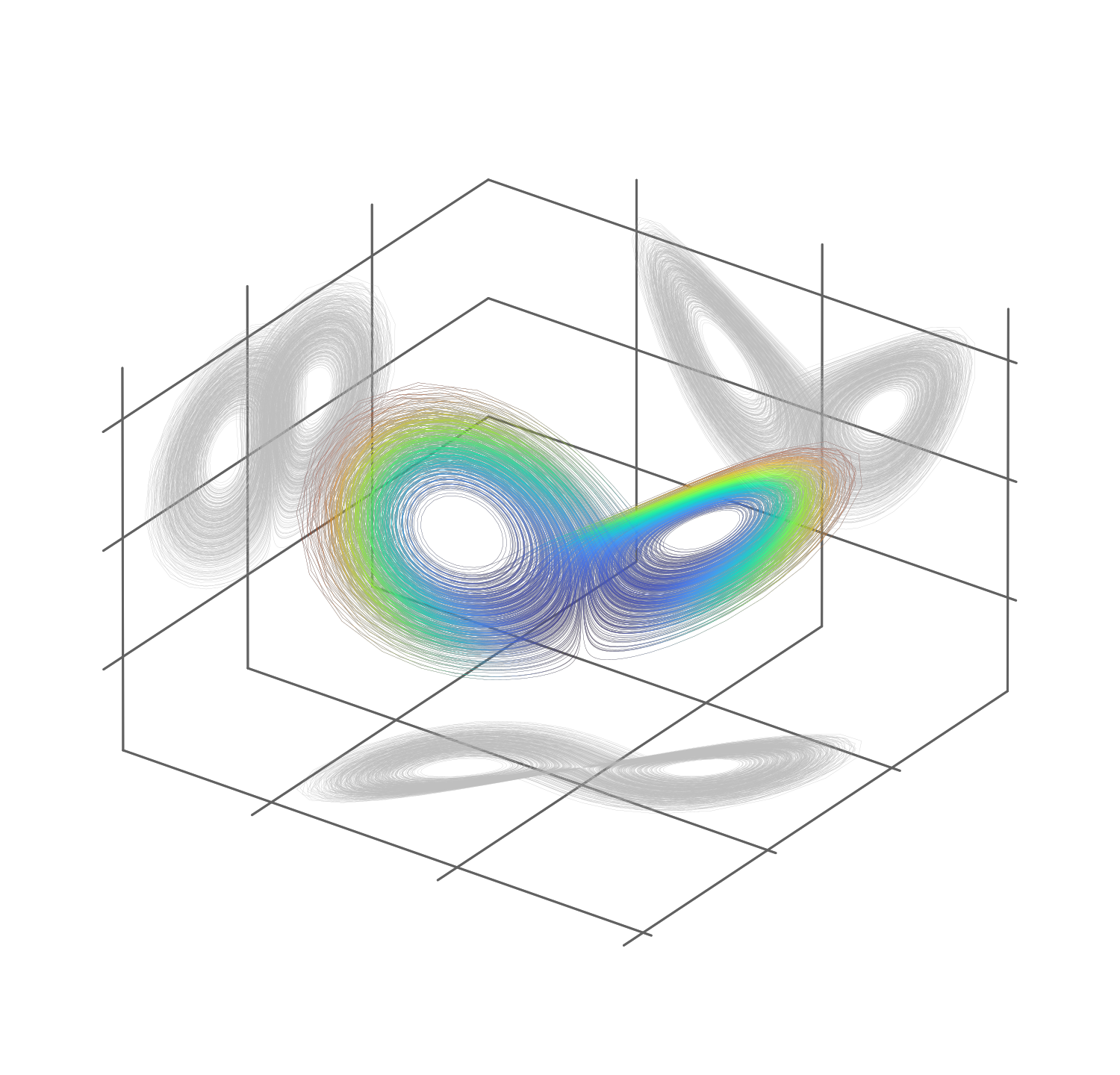
MoreMaps.jl
A flexible mapping framework for Julia that provides different parallel backends, progress tracking, and iteration patterns.
Features
Multiple backends: Sequential, Threaded, Distributed (
Pmap), andDaggermapexecutionProgress tracking:
LogLogger,ProgressLogger,TermLogger, andQualityLoggerNested array support: Map over specific leaf types in nested array structures
Cartesian (and arbitrary) expansions: Easy combinatorial iteration over inputs
Tuple / NamedTuple inputs: Map over
Tuples andNamedTuples, returning the same shapeDimensionalDatasupport: Map directly overDimensionarguments
Quick Start
using MoreMaps

# Basic usage with default sequential backend
x = rand(100)
C = Chart()
y = map(sqrt, C, x)

# Use threading for parallel execution
C_threaded = Chart(Threaded())
y_threaded = map(sqrt, C_threaded, x)

# Add progress tracking
C_progress = Chart(Threaded(), LogLogger(10))
y_progress = map(sqrt, C_progress, x)
100-element Vector{Float64}:
0.781206471888972
0.3462305850833009
0.9601627877702759
0.259467737255542
0.9619202031443926
0.5076781853947876
0.8039484125842029
0.5154530195789261
0.6138659753022729
0.7392649255169689
⋮
0.6780922306544371
0.9070121336698124
0.7419162552157301
0.8198371390120802
0.8766081209138298
0.44881458450263917
0.5367292377300185
0.48388201955454013
0.7560706146517433You can also pass a Backend or Progress value (or even the bare type) directly to map, and a default Chart wrapping it will be constructed for you:
using MoreMaps
x = rand(10)
map(sqrt, Threaded(), x)        # equivalent to map(sqrt, Chart(Threaded()), x)
map(sqrt, LogLogger(5), x)      # equivalent to map(sqrt, Chart(LogLogger(5)), x)
10-element Vector{Float64}:
0.6613306266297984
0.6669782608723176
0.4469366867276272
0.9716317644154471
0.12501830870081587
0.6849808430408669
0.8294139644594563
0.6408804794869865
0.7190037174003053
0.46804857496066654Basics
The basis of a MoreMaps map is the Chart type, which configures how mapping operations are executed.
A Chart is parameterised by four things:
backend: Specifies the execution backendprogress: Configures the progress logging behaviorleaf: The element type where recursion terminates, used for mapping nested arrays. Stored as a type parameter rather than a field.expansion: Determines how the input iterables are combined (e.g. Cartesian product). EitherNoExpansion()or aFunction.
A chart can be constructed using keywords or arbitrary-order positional arguments. The default Chart() reproduces Base.map(), and is constructed as:
C = Chart(backend   = Sequential(),    # No parallel execution; similar to Base.map
          progress  = NoProgress(),    # No progress logging
          leaf      = MoreMaps.All,    # Map over each element of the root array, like Base.map
          expansion = NoExpansion())   # Map over the original input arrays, as for Base.map

# Or, using positional arguments in any order. Each argument is dispatched on its
# type: `Backend` -> backend, `Progress` -> progress, `Type` -> leaf, `Function`
# -> expansion.
C = Chart(Sequential(), NoProgress(), MoreMaps.All, NoExpansion())

# Default behavior
C == Chart()
Mapping
Once you have a Chart, pass it to the standard Base.map function:
using MoreMaps

x = rand(10)
C = Chart()
y = map(sqrt, C, x)
y == map(sqrt, x)trueTuple and NamedTuple inputs are supported and the result is returned with the same shape:
map(x -> x^2, Chart(), (1, 2, 3))             # -> Tuple
map(x -> x^2, Chart(), (a = 1, b = 2, c = 3)) # -> NamedTuple
(a = 1, b = 4, c = 9)See the following pages for details on configuring a Chart:
Backends - Execution strategies (
Sequential,Threaded,Pmap,Daggermap)Progress - Progress tracking options (
LogLogger,ProgressLogger,TermLogger,QualityLogger,NoProgress)Leaves - Nested array handling
Expansions - Cartesian product and custom iterations